Happy 40th birthday. Welcome to your first (of many) perimenopause ads. Bone density? Brain fog? Hormone therapy?
Not long ago, there weren't many answers. Just ask your mother.
We've come a long way, but we still have far to go.
Menopause Is Finally Having It's Moment
For decades, women were told to push through menopause in silence, with few solutions designed for them. That silence is breaking, and the market is responding.
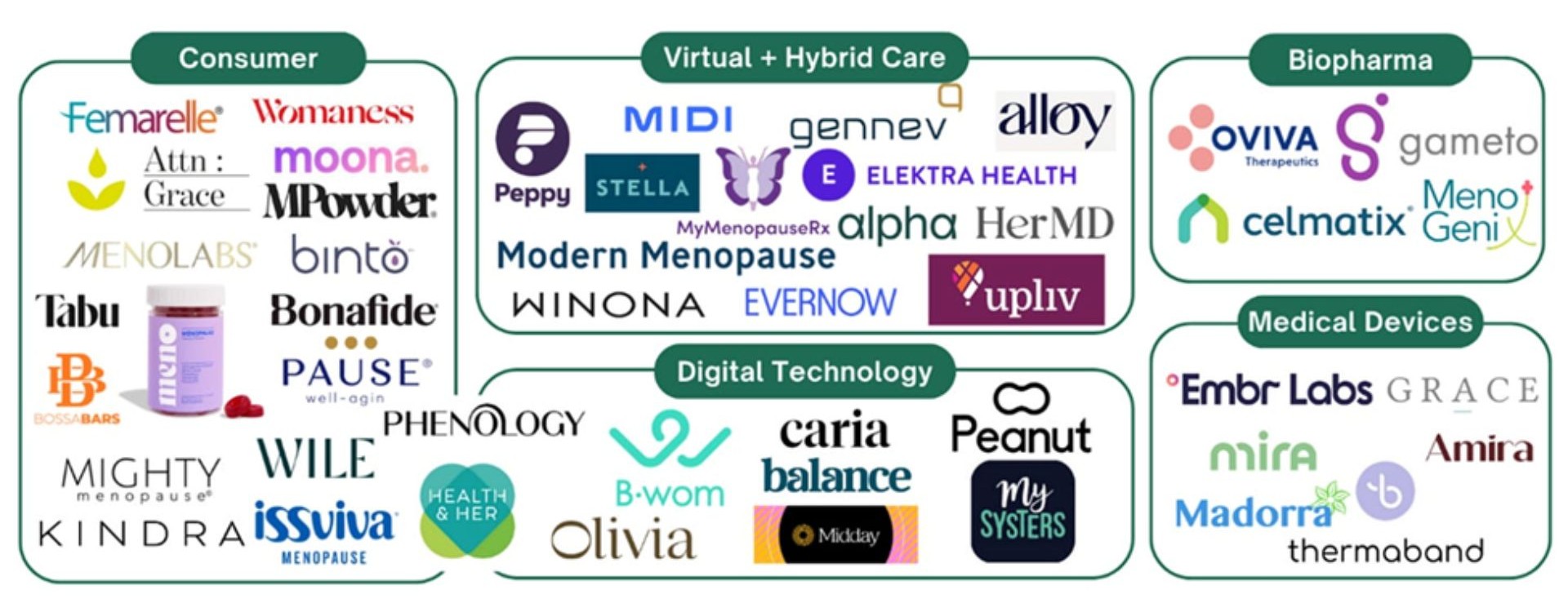
Approximately 1.3 million U.S. women enter the menopause transition each year, and by 2030, 1.2 billion women worldwide will be in some stage of the transition. Yet as recently as 2021, only about 5% of femtech startups addressed menopause. Today, the landscape looks very different. Take a look at SJF Ventures' grid with roughly 50 menopause companies across virtual care, consumer products, digital tools, biopharma, and devices.
Alone in 2025–2026 we've seen three signals investors can't ignore:
• Regulation shifted. In November 2025, the FDA announced it would remove the "blackbox" warning from menopausal hormone therapy, and it approved the updated labeling in early 2026. Two decades of fear around HRT is giving way to informed choice.
• New therapies arrived. Bayer's Lynkuet (elinzanetant) was FDA-approved in October 2025 as a hormone-free option for hot flashes, joining Astellas' Veozah.
• A category leader emerged. Midi Health raised a $100 million Series D in February 2026 at a valuation above $1 billion, becoming menopause care's first unicorn.
From One Moment to a Continuum
Menopause is not one stage. It is a continuum that can span decades.
• Perimenopause often begins in the 40s, with irregular cycles, mood changes, and sleep disruption. At-home hormone tracking, digital tools, and lifestyle support make earlier recognition and management possible.
• Menopause brings acute issues like hot flashes, cognitive shifts, and metabolic changes. Solutions now span hormone therapy, new non-hormonal drugs, devices, and supplements.
• Post-menopause shifts the focus to longevity. Bone density, cardiovascular health, and cognitive function come to the forefront, linking menopause directly to the healthy-aging movement.
Investors who treat menopause as a single moment will miss the richness of this continuum. Those who build for each stage will earn deeper loyalty and trust.
Innovation Takes Shape
The category is maturing, with clear leaders, fresh entrants, and the first real exits.

• Virtual + Hybrid Care: Midi Health now serves more than 25,000 patients a week with insurance-covered care. Alloy has taken a leaner path, reaching profitability on roughly $21 million raised. Elektra Health partnered with Oscar Health on HelloMeno, a menopause-focused ACA marketplace plan, and Visana Health closed a $24 million Series A with backing from The Cigna Group Ventures. Evernow and Halle Berry's Respin round out a crowded, fast-moving field.
• Consumer Products: Brands such as Womaness, Kindra, Stripes Beauty, and Winona are building targeted solutions across supplements, intimate care, and skin and body care. Retail is leaning in: Naomi Watts' Stripes expanded from a four-store pilot to 448 Ulta Beauty locations in July 2026, and Womaness has a dedicated, merchandised presence at Ulta.
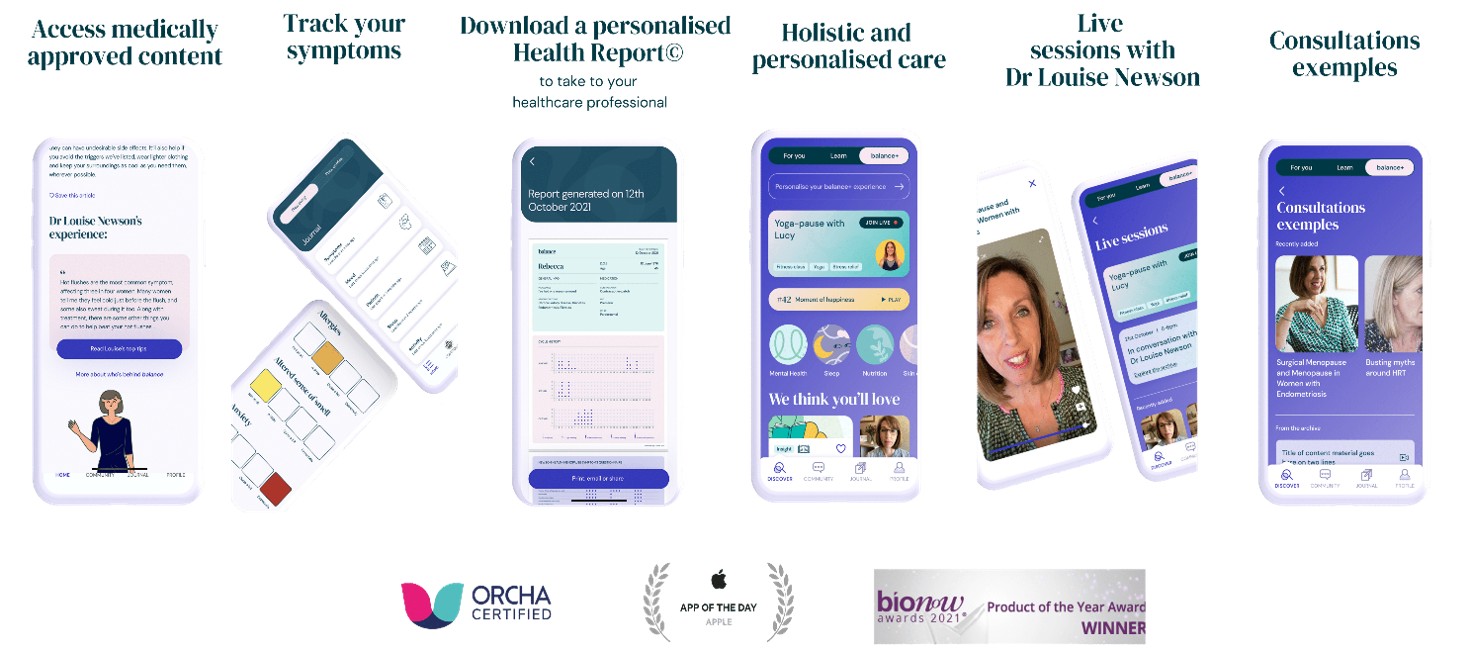
• Digital Technology: Apps like Balance(from Dr. Louise Newson), Caria, and Peanut track symptoms, deliver guidance, and connect women to community and care.
• Biopharma: Alongside Bayer and Astellas, whose Veozah generated an estimated $230–240 million in in-market sales in the first three quarters of its FY2025, Gameto raised a $44 million Series C and received an ARPA-H award to develop an implantable cell therapy for menopause. Ovarian-aging pioneer Oviva Therapeutics was acquired by Granata Bio in April 2026.
• Medical Devices: Boston's own Embr Labs targets hot flashes with its wrist-worn thermal device. Osteoboost offers the first FDA-cleared, non-drug treatment for osteopenia in postmenopausal women. Mira brings at-home hormone monitoring to perimenopause, and Madorra has FDA breakthrough device designation for a non-hormonal vaginal atrophy treatment.
Thanks to SJF Ventures for this grid:
The Market Opportunity with an Investor Lens
The financial potential is clear and it's growing steadily.
The U.S. menopause market is estimated at roughly $5.8 billion in 2025 to $6.2 billion, depending on scope, with forecasts reaching about $8 billion or more in the early 2030s. Globally, estimates put the market at about $18–19 billion in 2025, rising to roughly $29 billion by the mid-2030s.
The cost of doing nothing is significant: untreated menopause symptoms cost an estimated $25 billion a year in U.S. medical expenses and lost productivity.
Funding tells a more nuanced story. PwC estimates approximately $1.7 billion was invested in menopause-focused companies from 2020 through 2025, well above the roughly $530 million SJF Ventures tallied through early 2023. Across women's health overall, venture investment dipped in 2025 from the 2024 record, with Silicon Valley Bank projecting a rebound in 2026.
But the money is highly concentrated. Midi Health alone accounts for about 73% of publicly disclosed funding for U.S. menopause-specialist care companies.
Celebrity and cultural momentum continue to build. Amy Schumer, Tory Burch, Sheryl Sandberg, Connie Britton, and Brandi Chastain joined Midi Health's $63 million Series B, and Serena Williams' Serena Ventures joined its Series D.
Why Investors Should Move Now
Why Investors Should Move Now
Menopause solutions today combine recurring revenue with strong retention. They expand naturally into sleep, sexual wellness, mental health, weight management, and longevity.
Exit pathways are no longer theoretical. Pharmavite acquired Bonafide for $425 million, Nameless CPG acquired Wile, and consolidation is underway across care delivery and biotech.
Employers are moving too. According to SHRM's 2026 Employee Benefits Study, 27% of employers now offer menopause support, up from 18% just a year earlier.
At Compass Marketing, we spend a great deal of time helping brands identify these types of emerging whitespace opportunities. Each conversation starts with understanding how consumer expectations, behaviors, and anxieties are shifting in real time, then translating those insights into actionable growth strategies, innovation platforms, positioning opportunities, and product direction.

Lynda is a consumer marketing expert with a track record of successful U.S. and global product launches. She has created new product innovations across consumer wellness, from personal care to digital health. She is a founding partner of Compass Marketing.
See All Works